Our solid extracts are concentrated pastes made for gummies, functional beverages and other finished products. They’re easy to work with once the math is clear. This guide covers how to read the ratio, turn a target into a dose, plan a batch, and handle the paste in production.
What the ratio means
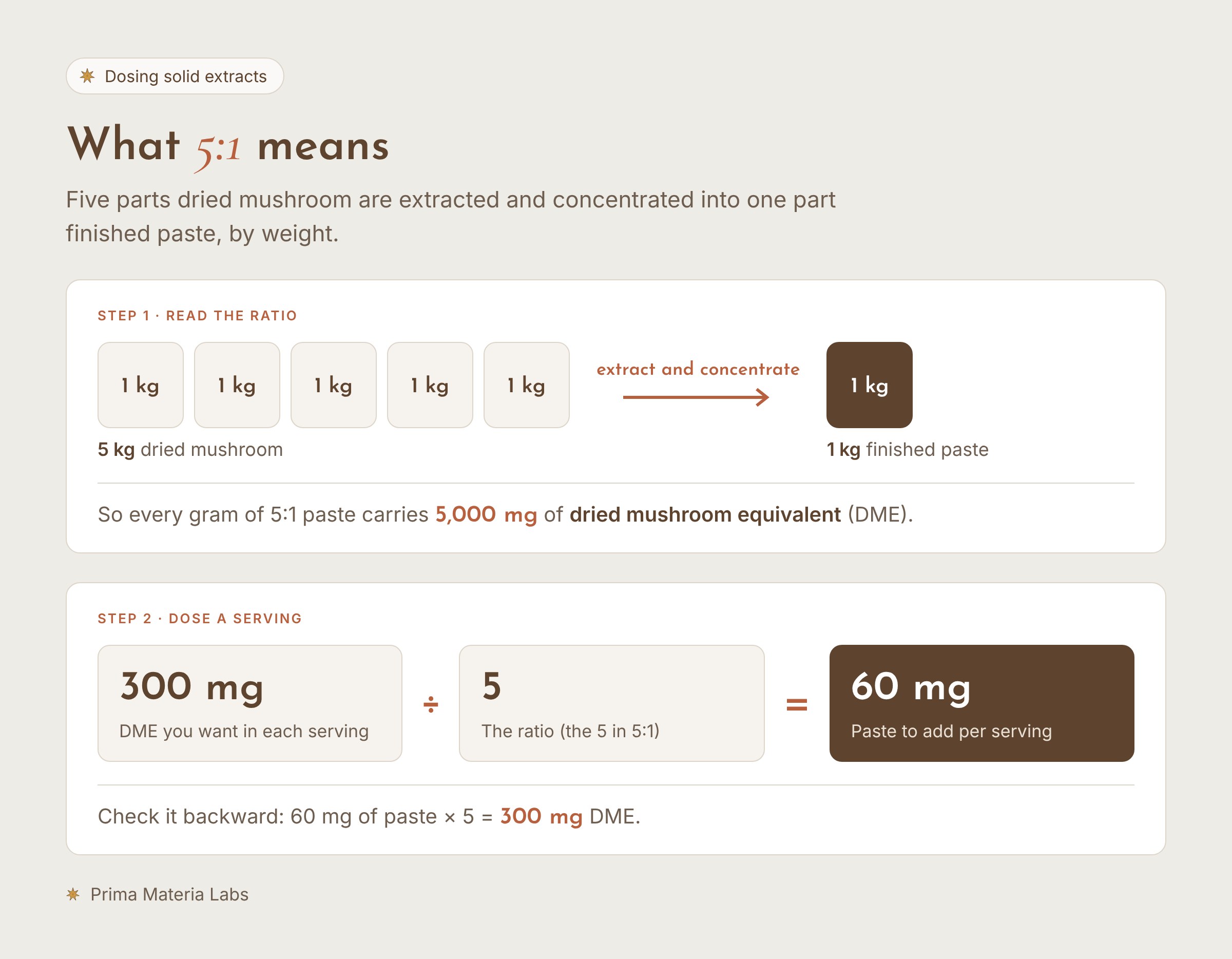
The ratio is dried starting material to finished concentrate, by weight. A 5:1 extract means 5 kg of dried mushroom was extracted and concentrated down to 1 kg of finished paste, as shipped. Residual moisture is already part of that weight, so you dose the paste exactly as you receive it.
That gives you a simple unit to work in: dried mushroom equivalent, or DME. One gram of a 5:1 concentrate carries 5,000 mg DME. A higher ratio means more dried material behind every gram, and less material to formulate around.
| Ratio | DME per 1 g | DME per 100 mg | Meaning |
|---|---|---|---|
| 3:1 | 3,000 mg | 300 mg | 3 kg dried to 1 kg paste |
| 5:1 | 5,000 mg | 500 mg | 5 kg dried to 1 kg paste |
| 8:1 | 8,000 mg | 800 mg | 8 kg dried to 1 kg paste |
| 10:1 | 10,000 mg | 1,000 mg | 10 kg dried to 1 kg paste |
The ratio for each lot is stated on its spec sheet and certificate of analysis.
A ratio is concentration, not potency
A ratio tells you how much dried material went in. It doesn’t tell you the beta-glucan or triterpene content, and ratios from different suppliers often aren’t comparable. A few reasons:
- Fresh or dry basis. Fresh mushrooms are roughly 80 to 95% water [1], so a ratio calculated on fresh weight can look many times better than the same material on a dry basis.
- What the “1” is. Finished paste, dry solids, or a powder dried onto a carrier like maltodextrin. A carrier dilutes the ratio back down after the fact.
- How well it was extracted. A ratio is only a weight relationship. The wrong solvent, time or temperature can recover very little and still produce the same number on paper.
So a 5:1 from one maker can carry less than a 1:1 from another. When you compare suppliers, ask how their ratio is calculated.
Turning a target into a dose
Work backward from the DME you want in each serving:
Extract per unit (mg) = target DME (mg) ÷ ratio
For example, 1,000 mg DME at 5:1 needs 200 mg of concentrate per gummy or serving.
| DME per dose | 5:1 extract | 10:1 extract | Doses per 1 g of 5:1 | Doses per 1 g of 10:1 |
|---|---|---|---|---|
| 100 mg | 20 mg | 10 mg | 50 | 100 |
| 250 mg | 50 mg | 25 mg | 20 | 40 |
| 300 mg | 60 mg | 30 mg | 16.7 | 33.3 |
| 350 mg | 70 mg | 35 mg | 14.3 | 28.6 |
| 500 mg | 100 mg | 50 mg | 10 | 20 |
| 1,000 mg | 200 mg | 100 mg | 5 | 10 |
Planning a batch
Concentrate needed (kg) = mg per unit × number of units ÷ 1,000,000, then add 3 to 5% for transfer loss.
For example, 60 mg per gummy across 20,000 gummies comes to 1.2 kg. Order 1.26 kg.
Where most products land
In our experience, 250 to 350 mg DME of a properly concentrated extract per gummy or serving is where most products settle. At 5:1, that’s 50 to 70 mg of concentrate per dose.
About 1,000 mg DME per serving has become a common baseline for mushroom ingredients in consumables. We’ve found that is usually more than our extracts need. A dried weight equivalent describes what went into the extraction, not what came out. In our experience, 300 mg DME of a well made extract can outperform 1,000 mg DME of material that wasn’t properly extracted.
- Below about 100 mg DME per serving, it’s hard to support a meaningful claim. Consider a higher DME.
- Above about 500 mg DME per serving, plan for flavor masking work, and for gummies, texture and set trials before you scale.
These are formulation guidelines drawn from production experience, not clinical dosing.
Working with a paste concentrate
- Solubility. Our pastes are highly water soluble, even at room temperature, so you can often reach a higher dose per serving than with powders, without the usual solubility problems.
- Mixing. Add the measured concentrate to a warmed solution for the easiest mixing. In water based solutions it typically blends with no sediment.
- Timing. Where your process allows, add it after the cook or boil step and before depositing, to protect the extract and its color.
- Gummies. The paste adds a small amount of moisture. Account for it in your water balance, confirm water activity, and run a bench trial before scaling.
- Beverages. Solubility can vary with pH and formulation, though most water based beverages have no issues.
- Yield and uniformity. Thick paste can cling to vessels, which is part of why we suggest 3 to 5% overage. Check your mix time, since dose uniformity comes from a well mixed slurry, not the deposit.
If you need a potency figure
We don’t standardize our extracts to beta-glucans or other compounds. Those compounds are there, but we don’t adjust batches to hit a set level, so the material varies within our approved specifications. If you need a potency figure for a specification or a label, tell us when you request a quote and we’ll work through it with you during development. Our article on whole and standardized extracts explains why we work this way.
Planning a gummy or beverage? Send us your target serving and quantities and we’ll help you run the numbers.
References
- Valverde ME, Hernández-Pérez T, Paredes-López O. Edible mushrooms: improving human health and promoting quality life. Int J Microbiol. 2015;2015:376387. https://doi.org/10.1155/2015/376387