Many ingredient spec sheets lead with a number: a percentage of beta-glucans, triterpenes, or another marker compound. That is standardization, and for a lot of products it is the right call. It gives you consistent figures, large volumes and a lower cost, and when a formula or a retailer depends on hitting a specific marker, it is often the only practical option.
We take a different approach with our mushroom extracts. We make whole extracts and don’t standardize them to a single marker or a small panel of them. Here is why, and what we control instead.
What standardization selects for
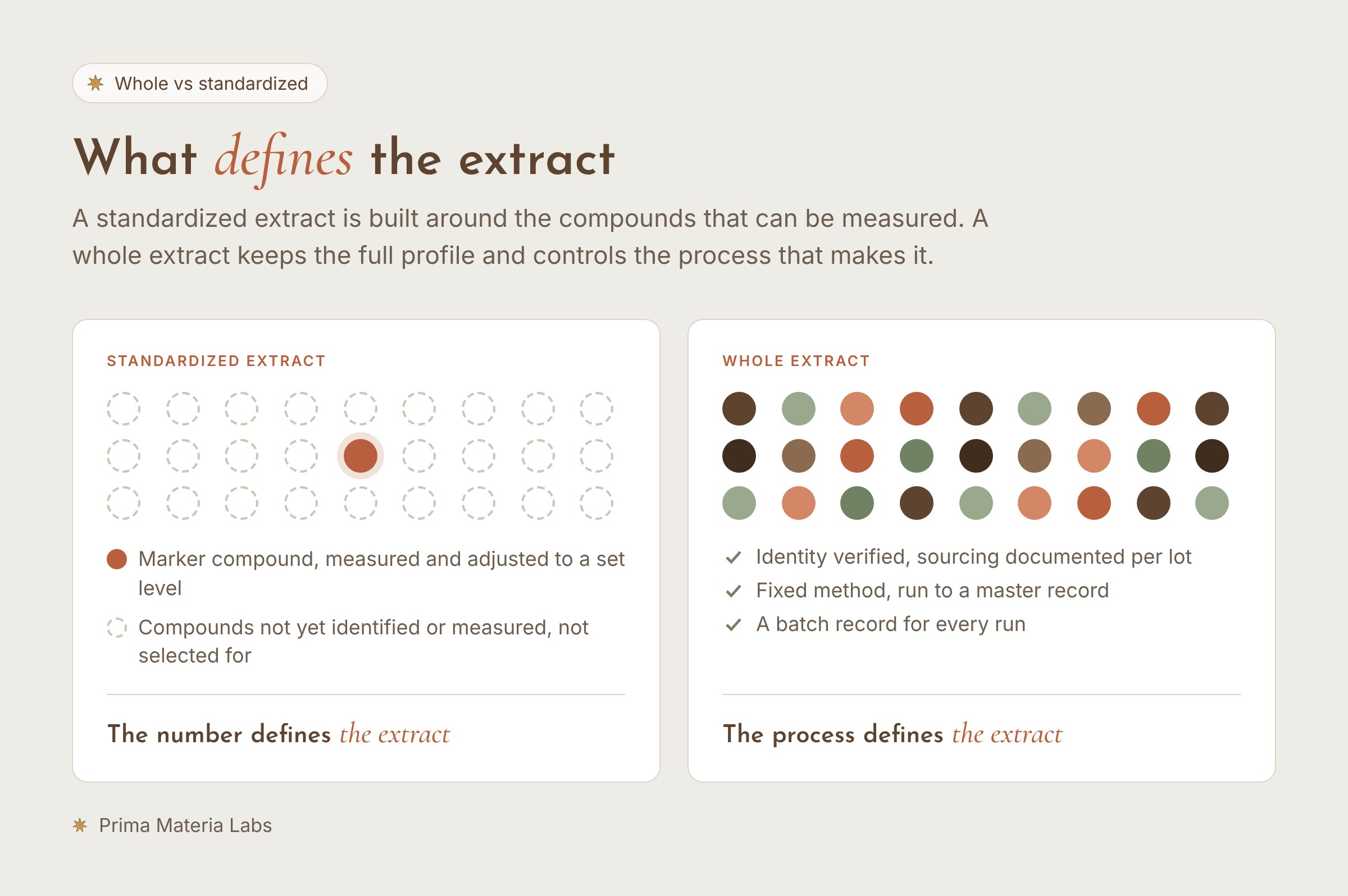
A standardized extract is adjusted so that a chosen compound lands at a set level. You can only standardize to what has been identified and can be measured reliably, and in mushrooms that is a small part of the chemistry. Compounds that haven’t been named yet aren’t selected for, and they can be reduced along the way to hitting the number.
So our position is fairly narrow. It isn’t that standardization is bad science. In several well studied botanicals it has worked, and much of their research rests on it. It’s that in fungi, a marker figure describes a minority of what is in the material.
A marker describes part of an extract
Some of the clearest evidence comes from the standardization side. The best known standardized ginkgo extract, EGb 761, is the one most of the major ginkgo research used. Scientists from its own manufacturer have written that its specification accounts for roughly 30% of the extract’s constituents, that the rest varies with how the extract is made, and that results from one ginkgo extract can’t be carried over to another produced differently [1]. Later lab work found activity in its proanthocyanidin fraction, which is not among the specified markers [2].
Hawthorn shows how nuanced this can be. In one lab study, fifteen individual hawthorn constituents tested on their own showed no activity, and purified procyanidin fractions were roughly five to ten times less effective than the whole extract [3]. In a different kind of study, a fraction enriched in one group of compounds did better than the whole extract [4]. The practical lesson is that enrichment helps when the enriched compounds are the ones that matter for your purpose, and can mislead when they aren’t.
What can be measured in mushrooms today
- Beta-glucans. The common enzymatic method calculates beta-glucan indirectly, as total glucan minus alpha-glucan, and the choice of hydrolysis step changes the result. Fully enzymatic versions give much lower values, and for some species, reishi among them, two acid methods give significantly different numbers [5]. The figure also says nothing about structure, and only part of the total is the branched, triple helix form researchers most often study [6].
- Triterpenes. There is no single method of record. Broad colorimetric tests estimate the whole class against an outside reference standard, while chromatographic methods measure specific named compounds, so results from different methods aren’t directly comparable. A percentage on a label means little without the method behind it.
- Identity. The most dependable test in this category is whether the material is what it says it is. The ITS region of fungal DNA is the accepted barcode for identifying species [7], and it can work on dried, milled and extracted material [8]. That matters in a market where a survey of reishi supplements sold in the US found only 5 of 19 matched their labels [9], and a survey of cordyceps products sold online found more than half were falsified [10].
How we verify identity
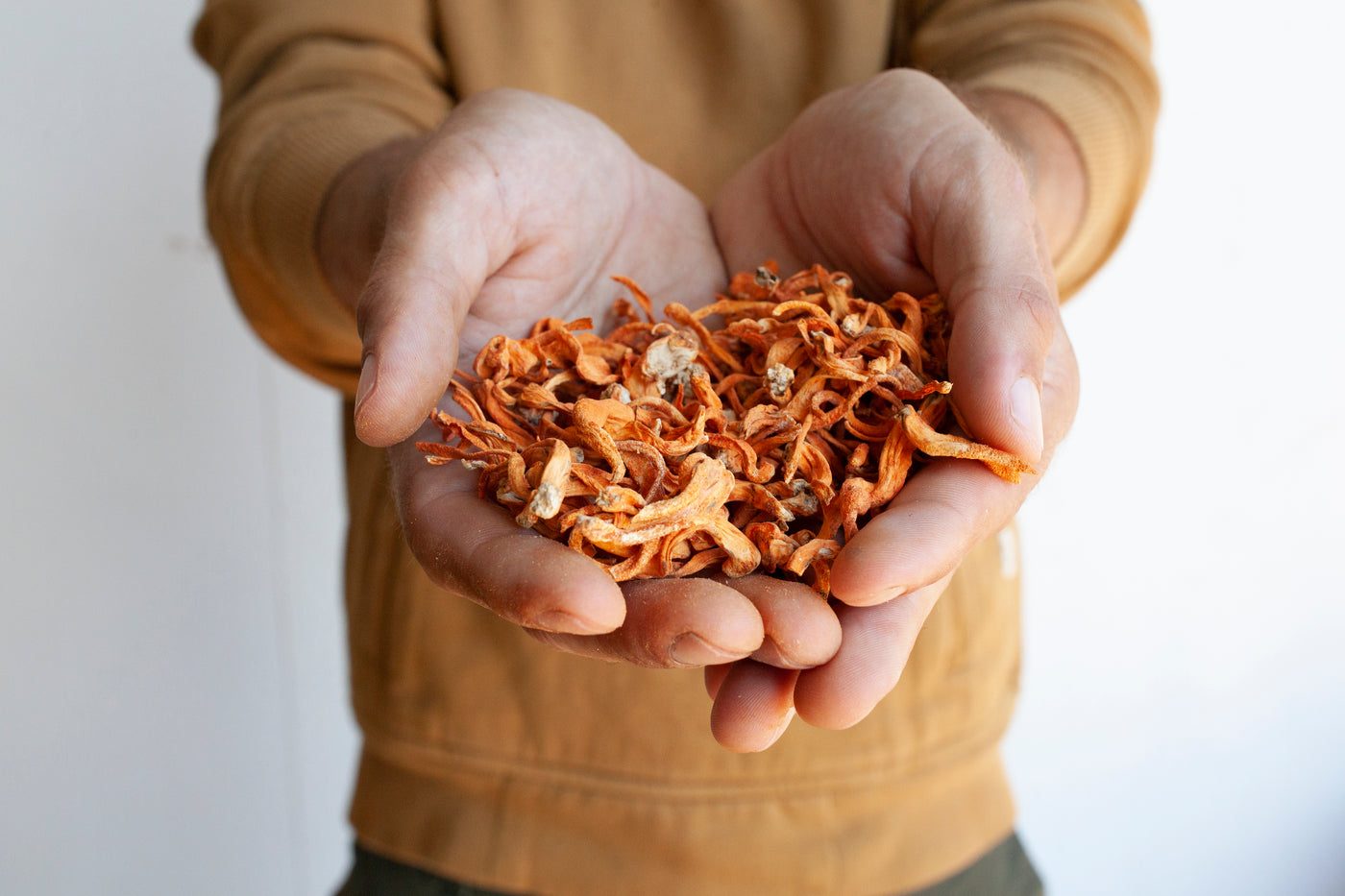
Because we work with whole mushrooms and cut and sift herbs rather than powders, our primary method is visual identification of the whole material. The features that identify a species are still there to see, and so is anything that doesn’t belong, like another species, soil, substrate or other foreign matter. Macroscopic identification is one of the oldest ways of authenticating medicinal materials and is still a standard first step [11]. Once material is powdered, most of those features are gone.
When a material calls for more, laboratory methods add another layer:
- HPTLC (high performance thin layer chromatography) compares a sample’s chemical fingerprint side by side with authenticated reference material, and can reveal substitute species and added material [12].
- HPLC (high performance liquid chromatography) separates individual compounds, giving a detailed fingerprint and a way to confirm expected compounds and spot unexpected ones [13].
- NMR (nuclear magnetic resonance) spectroscopy captures a broad profile of the compounds present in a single measurement, so differences in overall composition show up even when a single marker looks normal [14].
Pharmacopoeias rely on this same mix of visual and chemical methods for botanical identity, and it matters: in a review of commercial herbal products checked with chemical methods, more than a quarter were adulterated [15].
What we hold constant instead
Not standardizing doesn’t mean not controlling. What we keep constant is the process:
- A defined species and plant part, identified as whole material and confirmed with lab methods when needed, rather than taken from a supplier’s label.
- Domestically sourced cultivated and wild harvested material, with the source documented for each lot.
- A fixed extraction and concentration method, run to a master manufacturing record, with a batch record for every run.
- Finished extracts that vary within approved specifications. Natural material varies, and we’d rather say so plainly.
When you need a number
Some products do need a marker figure, for a specification, a retailer, or a formula built around a specific compound. We can develop targeted enrichment within our extraction methods, and we can quote testing against a marker. Tell us when you request a quote and we’ll let you know whether we can meet it.
Arguments we leave out
Some popular arguments for whole extracts don’t hold up, so we don’t use them. The cannabis “entourage effect” is often cited, but current reviews find limited evidence for it [16, 17]. The idea that a beta-glucan percentage predicts how potent a mushroom extract is isn’t supported either. We hold our own recommendations to the same standard: when we suggest a lower dried mushroom equivalent than the category norm, that comes from production and customer experience, and we describe it that way.
For how this works in a formula, see our guide to dosing solid extracts.
References
- Kulić Ž, Lehner MD, Dietz GPH. Ginkgo biloba leaf extract EGb 761® as a paragon of the product by process concept. Front Pharmacol. 2022;13:1007746. https://doi.org/10.3389/fphar.2022.1007746
- Lejri I, Vukalović I, Grimm A, Eckert A. Proanthocyanidins from Ginkgo extract EGb 761® improve bioenergetics and stimulate neurite outgrowth in vitro. Front Pharmacol. 2025;16:1495997. https://doi.org/10.3389/fphar.2025.1495997
- Halver J, Wenzel K, Sendker J, et al. Crataegus extract WS®1442 stimulates cardiomyogenesis and angiogenesis from stem cells: a possible new pharmacology for hawthorn? Front Pharmacol. 2019;10:1357. https://doi.org/10.3389/fphar.2019.01357
- Chatterjee SS, Koch E, Jaggy H, Krzeminski T. In vitro and in vivo studies on the cardioprotective action of oligomeric procyanidins in a Crataegus extract of leaves and blooms. Arzneimittelforschung. 1997;47(7):821-825. PubMed 9324931
- McCleary BV, Draga A. Measurement of β-glucan in mushrooms and mycelial products. J AOAC Int. 2016;99(2):364-373. https://doi.org/10.5740/jaoacint.15-0289
- Nitschke J, Modick H, Busch E, et al. A new colorimetric method to quantify β-1,3-1,6-glucans in comparison with total β-1,3-glucans in edible mushrooms. Food Chem. 2011;127(2):791-796. https://doi.org/10.1016/j.foodchem.2010.12.149
- Schoch CL, Seifert KA, Huhndorf S, et al. Nuclear ribosomal internal transcribed spacer (ITS) region as a universal DNA barcode marker for Fungi. Proc Natl Acad Sci USA. 2012;109(16):6241-6246. https://doi.org/10.1073/pnas.1117018109
- Raja HA, Baker TR, Little JG, Oberlies NH. DNA barcoding for identification of consumer-relevant mushrooms: a partial solution for product certification? Food Chem. 2017;214:383-392. https://doi.org/10.1016/j.foodchem.2016.07.052
- Wu DT, Deng Y, Chen LX, et al. Evaluation on quality consistency of Ganoderma lucidum dietary supplements collected in the United States. Sci Rep. 2017;7(1):7792. https://doi.org/10.1038/s41598-017-06336-3
- Wirasathien L, Sriputhon N, Tangkiatkumjai M. Post-marketing surveillance of cordyceps products online: identifying falsified products and regulatory challenges. BMC Complement Med Ther. 2026;26(1):184. https://doi.org/10.1186/s12906-026-05363-w
- Zhao Z, Liang Z, Ping G. Macroscopic identification of Chinese medicinal materials: traditional experiences and modern understanding. J Ethnopharmacol. 2011;134(3):556-564. https://doi.org/10.1016/j.jep.2011.01.018
- Frommenwiler DA, Reich E, Sudberg S, et al. St. John’s wort versus counterfeit St. John’s wort: an HPTLC study. J AOAC Int. 2016;99(5):1204-1212. https://doi.org/10.5740/jaoacint.16-0170
- Goodarzi M, Russell PJ, Vander Heyden Y. Similarity analyses of chromatographic herbal fingerprints: a review. Anal Chim Acta. 2013;804:16-28. https://doi.org/10.1016/j.aca.2013.09.017
- Booker A, Frommenwiler D, Johnston D, et al. Chemical variability along the value chains of turmeric (Curcuma longa): a comparison of nuclear magnetic resonance spectroscopy and high performance thin layer chromatography. J Ethnopharmacol. 2014;152(2):292-301. https://doi.org/10.1016/j.jep.2013.12.042
- Ichim MC, Booker A. Chemical authentication of botanical ingredients: a review of commercial herbal products. Front Pharmacol. 2021;12:666850. https://doi.org/10.3389/fphar.2021.666850
- Christensen C, Rose M, Cornett C, Allesø M. Decoding the postulated entourage effect of medicinal Cannabis: what it is and what it isn’t. Biomedicines. 2023;11(8):2323. https://doi.org/10.3390/biomedicines11082323
- Simei JLQ, Souza JDR, Lisboa JR, et al. Does the “entourage effect” in cannabinoids exist? A narrative scoping review. Cannabis Cannabinoid Res. 2024;9(5):1202-1216. https://doi.org/10.1089/can.2023.0052